She Smiled Afterward
What I witnessed in a high-control community — and what it tells us about the psychology of harm

TRIGGER WARNING
This article contains a firsthand account of violence against children, including a detailed description of a physical attack. It also contains discussion of the psychology of people who harm children. If you are a survivor of childhood abuse, please read only when you are in a safe and supported space. Resources are listed at the end of this article.

| Series: Understanding What Happened to Us
I am fifty-five years old. And I am still affected by the things I witnessed as a child.
That is exactly what this series is for. I know that, if these things still affect me – they affect other survivors as well. In hearing my stories, others can approach their own.
I often write about high-control religious communities and what they do to the people inside them. Usually we talk about the theology, the information control, the submission requirements. Today let’s talk about what happens in the rooms where the theology is enforced with a body and a weapon. This is a hard topic, and many of you may have experienced things like I’m describing here. Please be gentle with yourself and read this when you have the emotional support and bandwidth you need.
I was staying at a family’s home. I grew up Two by Two, so I had been spanked with a wooden spoon and a belt. I had witness other children being spanked. Adults put us across their laps and spanked us. That was the established pattern. These boys were about my age.
What I witnessed this day was different. The boys had not done what their mom had told them to do.
She went and got a metal arrow she kept for this purpose, went to their room, and began chasing them around the room. They ran. She swung the arrow and it connected — and when it did, you could see that it stung. I heard the concussion every time she connected. Every time. They screamed and cried and ran. But they couldn’t get away. There was no exit that worked. The chasing was part of it — she was terrorizing them at the same time as the physical attack. And she called it spanking.
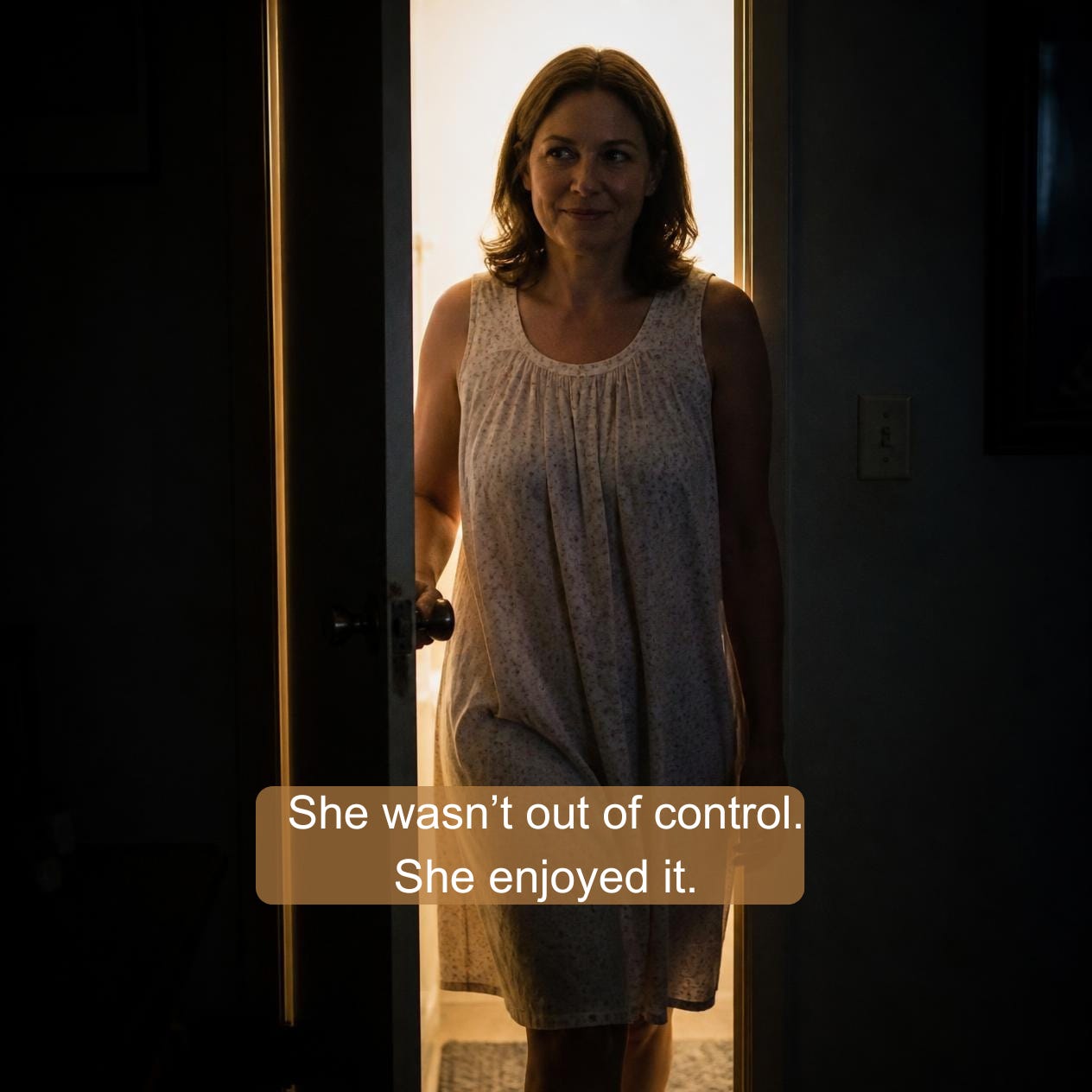
When it was over, she walked out of the room. She made eye contact with me.
She was smiling. She was trying to hide it — you could see that she knew she shouldn’t be smiling, that it was the wrong expression for what had just happened. But she was smiling. She had liked it. And the eye contact felt like it placed me on her side. That feeling was extremely complicated for me because I didn’t want to be on her side, but I didn’t want to be on the other side getting hit and terrorized. And, somehow, in that eye connection, I felt responsible for what had just happened to my friends. Like it was now my fault for being on their mom’s side.
I was a child. I didn’t have language for what I had witnessed. I only knew that something had happened that felt deeply, fundamentally wrong — and that the wrong thing wasn’t just what she had done to her boys. It was also that look on her face walking out.
Over forty years later, I can describe those scenes in detail because they are seared in my memory. I can’t think of them without feeling the emotions of that moment.
What the Smile Was
Let’s talk about that smile.
Physical violence against someone you have power over produces a neurological event. The tension that preceded it — the anger, the frustration, the feeling of being out of control, whatever drove the person to pick up the weapon — discharges in the act of violence. What follows is a brief period of relief. Sometimes something close to euphoria. The body has released something it was holding, and it registers that release as good.
That’s what it was. She felt relieved.
There is also a power component. For someone who feels powerless in some dimension of their life — and in high-control religious communities, adult women often exist in a rigid hierarchy where they have very little power — exerting physical dominance over a child who cannot effectively resist produces, in some personality configurations, a genuine sense of control. A sense of being, briefly, the one who decides. The one who cannot be questioned. The one who cannot be stopped.
The chasing mattered. It wasn’t incidental. The terror and the physical attack were fused together deliberately, even if not consciously. The power was not just in the hitting. It was in the running. It was in the knowledge that there was nowhere to go. She was not simply punishing her children. She was demonstrating to them, and perhaps to herself, that she was absolute in this room.
And then she walked out smiling because she liked how it felt.
What I Know from Having Been There
We don’t like to think about this. In my experience of being around abuse — in a high-control religious community, in households where physical punishment was normalized and routine — the people who hurt others often enjoyed it.
The woman with the metal arrow was not in a rage she couldn’t control. She wasn’t past herself with anger. She was deliberate. She chased. She aimed. She watched what happened when the arrow connected. She heard the terror in her boys’ screams. And she walked out smiling.
She enjoyed it.
I know this is an uncomfortable thing to say. Our narratives about abuse tend to prefer the version where the abuser was out of control, didn’t know what they were doing, was themselves in pain, needed compassion and understanding. And sometimes those things are true. People who abuse were often abused themselves. Cycles are real. Trauma is real.
But the preference for that narrative — the version where the abuser couldn’t help it — serves the abuser more than it serves the survivor. It removes intention. It removes accountability. And for the child in the room who watched it happen, it asks them to hold a story that doesn’t match what they saw.
What I saw was enjoyment.
Enjoyment that she knew she needed to hide. Which means she also knew, on some level, that enjoying it was wrong. The hiding of the smile is important — it tells us that she was aware enough to know the response was inappropriate. She wasn’t absent from the moment. She was fully present in it, and she felt something she couldn’t quite suppress when it was over.
The research on people who commit violence against others documents this. Neurologically, physical dominance over someone who cannot resist can produce genuine reward responses — relief, satisfaction, a sense of power and control. For some people, in some configurations, causing fear and pain produces something that registers in the body as good. This is not speculation. It is documented.
And in communities where physical punishment is theologically endorsed, publicly modeled, and socially normalized, the inhibitions that might otherwise suppress this response are reduced. The enjoyment can develop or deepen because there is no social check on it. God approves. The community approves. The child deserved it. There is nothing to suppress.
I am telling you this because I think survivors deserve to have their perceptions validated.
If you were in a room where someone hurt you or hurt someone near you, and some part of you understood that the person doing it was not simply out of control — that they were getting something from it — you were not wrong. You saw something real. You knew it. You were right. You are not crazy to know what you know.
What you saw was real. You were right to know it. In the knowing is the beginning of healing.
What I Was, Watching
I was a child standing in that room. And I want to name something about what it is to be a witness to violence against other children, because this too is a part of the story that rarely gets told.
When children watch other children be punished — really punished, chased and hit and terrorized — there is a complicated emotional response. There is fear, because what is happening in front of you is frightening and your body registers it as a threat even when it isn’t aimed at you. There is relief, because it isn’t you. And that relief is not a small thing. In the nervous system of a child who has grown up inside a community where punishment is regular and public, the relief of not being the target is enormous. It discharges as something that can look like laughter, or stillness, or a strange and wrong-feeling calm.
That calm doesn’t mean you weren’t affected. I was affected. I am still affected. The image of those boys running and the look on her face when she walked out has lived in my body for five decades.
Witnessing harm is its own form of harm. The children in that room who were not being hit were also being trained. They were learning that this is what power looks like. That this is what adults do. That there is no appeal and no exit and no one is coming.
Why Communities Protect This
What happened in that room was not a secret. It happened with a witness present. It happened in a home that was embedded in a religious community. And that community — like most high-control communities — had no effective mechanism for naming it, stopping it, or protecting the children inside it.
This is not incidental. It is structural.
High-control religious communities are specifically organized to remove the tools a person would need to name harm and demand accountability. The theology of submission means that a mother’s authority over her children is essentially absolute. The theology of forgiveness means that any harm, once committed, must be released rather than addressed. The information control means that outside perspectives — including perspectives that would name what happened in that room as abuse — are preemptively discredited.
The smiling mother was protected by every layer of that system. Not because the community approved of what she did — I cannot know what anyone around her thought or knew. But because the system was specifically designed to make naming it nearly impossible.
I’m telling this story now – but I’ve never told it before. It did not occur to me to tell at the time, and I never told anyone the story later, either. The boys and I never discussed it – and we were close. They were some of my closest friends in the sect.
Children do not generally report abuse in high-control communities. Not because they don’t know something is wrong. They know. I knew. I simply had zero belief that anyone would do anything about it or respond in any kind of helpful way. It was more likely that I would get blamed for talking about it, and I had already learned not to talk about these things.
The community had already told me that my inner voice — the one saying something is wrong — is the flesh, the will, the enemy of God. And so I stayed quiet.
What Stays
I am fifty-five years old and I can still feel the quality of the air in that room.
This is what childhood trauma does. It doesn’t live in the mind as a story you remember. It lives in the body as a stored event that the nervous system keeps available — keeps accessible — in case it becomes relevant again. The body doesn’t know it’s fifty years later. The body knows that something dangerous happened in a room like this, and it wants to be ready.
For survivors of high-control communities, this kind of stored experience is not unusual. Many of us carry rooms we can still feel. Faces we can still see. The specific quality of fear in a particular place at a particular time that the nervous system has decided is too important to release.
Healing is, in part, the slow work of telling the nervous system: you are not in that room anymore. The danger that was real then is not present now. You can put it down.
That work takes time. It takes support. And it starts with being able to say clearly, without minimizing, without explaining away: what happened in that room was wrong. The boys running from their mother with a metal arrow were being harmed. What I saw on her face when she walked out was real. And it has haunted me because it was traumatizing. The body was right to hold it.
It was worth remembering. It still is.
A Question for You
Is there a room you can still feel — a moment of witnessed harm that your body has held for years? What would it mean to say, simply and without qualification: that was wrong, and I was right to be affected by it?
If this article brought something up — the door is open. The Little Mouse and the Purple Door Journal is a private space to do that work on your own terms, with no one watching.
Resources
Books
Little Mouse and the Purple Door — Amazon
Little Mouse Journal — Amazon
Little Bea and the Golden Key — Amazon
Little Bea Journal — Amazon
Author’s Work
purpledoorjourneys.com
TikTok: @littlemousepurpledoor
If you are in crisis or need immediate support:
988 Suicide and Crisis Lifeline — call or text 988
Crisis Text Line — text HOME to 741741
For survivors of childhood abuse:
RAINN — rainn.org | 1-800-656-4673
Childhelp National Child Abuse Hotline — 1-800-422-4453
For religious trauma recovery:
Religious Trauma Institute — religioustraumainstitute.com
Recovering from Religion Foundation — recoveringfromreligion.org
Two by Two Survivor Resources:
Advocates for the Truth — advocatesforthetruth.com | Hotline: 1 (503) 386-4634
Wings for Truth — wingsfortruth.info
Telling the Truth — tellingthetruth.info
Series: Understanding What Happened to Us | June 2026 | Meliesa Tigard | purpledoorjourneys.com | TikTok: @littlemousepurpledoor
I always thought I'd write about what it was like growing up in a Dominionist family. But I find I can't breathe when I try. I can write around what happened in those rooms, but don't have what it takes to write about that little girl who always thought she was an adult. I'm so glad you are writing about what happened to you.
Her smile could also have a sexual component in the mom’s enjoyment of power over and of beating and hurting her children.